I remember a time when I didn’t fully understand the meaning of ego, but I could clearly feel its effect in my daily life. I used to react quickly whenever I felt disrespected or misunderstood, even in small situations that did not really matter.
At that time, I thought I was just protecting myself, but later I realized it was my ego controlling my reactions instead of my calm thinking.
There was a moment in my life when a small disagreement turned into a serious argument. I kept trying to prove I was right, even when I knew deep inside that it was not worth it.
After that situation, I felt disappointed in myself because I realized I had let my ego damage a relationship that mattered to me.
From that experience, I started to reflect on my behavior and slowly understood what ego really means.
It is not just confidence, but the feeling that pushes us to always be right and avoid accepting mistakes. This realization helped me grow and learn how to respond more calmly in similar situations.
What is Ego? Simple Meaning Explained
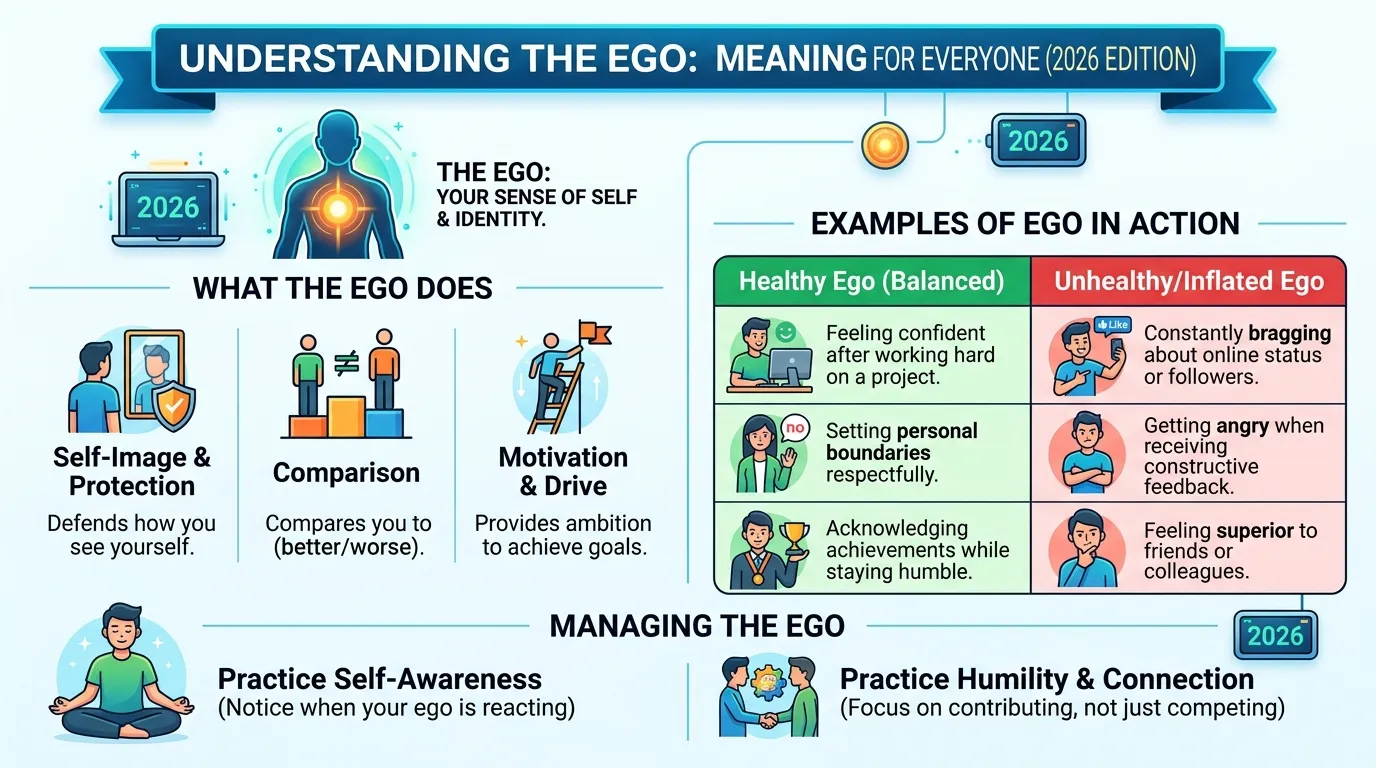
Ego refers to a person’s sense of self or identity. It is how you view yourself and how you separate “you” from others.
In simple words, ego is your inner voice that says:
- “This is who I am”
- “This is what I deserve”
- “This is how I should be treated”
Ego is not always negative. It helps you make decisions, protect your self-respect, and understand your place in society.
Ego Meaning in Psychology (Freud’s Theory Explained)
In psychology, especially in the theory of Sigmund Freud, the mind is divided into three parts:
- Id → Driven by desires and instincts
- Ego → The rational part that makes logical decisions
- Superego → The moral part that understands right and wrong
The ego works as a “middle manager” between desires (id) and morality (superego). It helps a person make realistic and balanced decisions instead of acting purely on emotion or strict rules.
For example, if you are angry but choose to stay calm and respond wisely, that is your ego controlling the situation.
Ego Meaning and Examples
The word ego refers to the way a person thinks about themselves. It is connected to confidence, pride, and self-importance. A healthy ego helps people believe in themselves and stay motivated. However, too much ego can make someone arrogant or unwilling to listen to others.
In daily life, people often use the word ego when talking about attitude or behavior. For example, someone may refuse help because their ego does not allow them to admit weakness. On the other hand, a person with balanced ego can accept mistakes and learn from them.
Here are some simple examples of ego in sentences:
- His ego stopped him from saying sorry after the argument.
- She has a strong ego, but she still respects others.
- Winning the competition boosted his ego.
- A big ego can sometimes damage friendships.
- He kept calm and did not let his ego control the situation.
Ego is not always negative. It can help people feel confident and proud of their achievements. Problems usually begin when ego becomes more important than kindness, teamwork, or understanding others.
In psychology, ego is also a term used to describe the part of the mind that balances desires and reality. It helps people make practical decisions and control emotions.
Understanding ego can improve communication, relationships, and personal growth. When people manage their ego wisely, they become more open-minded, respectful, and emotionally strong.
Ego in Modern Psychology and Daily Behavior
In modern psychology, ego is seen as:
- Self-image
- Self-esteem
- Personal identity
It influences how you react to criticism, success, failure, and social situations. A strong ego can help build confidence, while an unhealthy ego can create emotional problems.
Types of Ego
1. Healthy Ego (Balanced Ego)
A healthy ego means:
- Self-respect without arrogance
- Confidence without insecurity
- Ability to accept mistakes
People with a balanced ego are emotionally stable and socially adaptable.
2. Inflated Ego (Overactive Ego)
This type of ego leads to:
- Arrogance
- Superiority complex
- Refusing to accept mistakes
- Constant need to be right
This can damage relationships and limit personal growth.
3. Weak or Low Ego
A weak ego includes:
- Low self-confidence
- Fear of rejection
- Over-dependence on others
- Difficulty making decisions
This type of ego often leads to insecurity and emotional imbalance.
Ego vs Confidence – Key Differences
Many people confuse ego with confidence, but they are not the same.
- Ego is defensive and seeks validation from others
- Confidence is stable and comes from self-belief
Example:
- Ego says: “I am better than everyone else”
- Confidence says: “I am good at this, and I can improve more”
Confidence builds connections, while ego can create distance.
Real-Life Examples of Ego
Ego in Relationships
In relationships, ego often appears when:
- People refuse to apologize first
- Small issues turn into big arguments
- Pride becomes more important than understanding
Ego in Workplace
At work, ego can show up as:
- Ignoring feedback from supervisors
- Competing instead of collaborating
- Refusing to admit mistakes
Ego in Friendships
Friendships can suffer when:
- Friends compete instead of support each other
- Misunderstandings are not cleared due to pride
- Communication breaks down
Ego in Education
Students may avoid asking questions because:
- They don’t want to look “less smart”
- They fear judgment from others
This limits learning and growth.
Positive Side of Ego
Ego is not always harmful. A healthy ego provides:
- Self-respect and personal boundaries
- Motivation to achieve goals
- Protection from toxic behavior
- Strong decision-making ability
When balanced, ego becomes a strength.
Negative Side of Ego
Uncontrolled ego can lead to:
- Broken relationships
- Poor communication
- Constant conflicts
- Emotional stress
- Lack of personal growth
Too much ego creates distance between people.
Psychological Signs of an Unhealthy Ego
Some common signs include:
- Not accepting criticism
- Always wanting to be right
- Difficulty apologizing
- Feeling superior or inferior
- Ignoring others’ opinions
These behaviors can harm both personal and professional life.
Causes of Ego Development
Ego is shaped by many factors:
- Childhood upbringing
- Social environment
- Past success or failure
- Cultural influence
- Personal insecurities or achievements
Everyone develops ego differently based on life experiences.
How to Control Ego in Daily Life
Managing ego is important for emotional balance. You can control ego by:
- Practicing self-awareness
- Listening to others without judgment
- Accepting mistakes openly
- Developing emotional intelligence
- Staying humble in success
Control, not elimination, is the key.
Ego in Relationships – How to Handle It
Healthy relationships require balance between love and ego.
To manage ego in relationships:
- Communicate clearly
- Apologize when needed
- Avoid unnecessary arguments
- Focus on understanding, not winning
Strong relationships are built on respect, not pride.
Ego and Personal Growth
A balanced ego helps in:
- Leadership skills
- Better decision-making
- Confidence in challenges
- Continuous self-improvement
Successful people often have controlled ego, not no ego.
Common Misconceptions About Ego
Many people misunderstand ego:
- Ego is always bad → ❌ False
- Ego means confidence → ❌ Not exactly
- Ego cannot be controlled → ❌ Incorrect
Ego is natural; only imbalance causes problems.
Conclusion:
Ego is not something negative or positive by itself. It becomes helpful or harmful depending on how it is managed.
A balanced ego gives confidence, self-respect, and direction in life, while an uncontrolled ego leads to conflict and emotional imbalance.
The real goal is not to remove ego but to understand and control it for a healthier and more successful life.